
 Deutsch
 English

Anyone putting together a gaming PC today will sooner or later come across two terms that appear more and more frequently in hardware discussions: Raytracing and Pathtracing. Both technologies represent a new generation of graphics rendering that calculates light, shadows, and reflections far more realistically than classic rendering methods. At the same time, they are considered one of the most important reasons why many gamers reach for powerful—and accordingly more expensive—graphics cards.
But why do these technologies require so much computing power? And what exactly is the difference between Raytracing and Pathtracing? This article is dedicated to precisely these questions. We first explain the basics of modern graphics computation and show the difference between classic rasterization and raytracing. We then take a look at pathtracing as the currently most realistic form of light simulation and explain why this method pushes even current high-end graphics cards to their limits.
In addition, we shed light on how technologies such as DLSS and other upscaling methods can help make raytracing in games practical at all. Finally, we look at well-known games that are famous for their raytracing or pathtracing implementations and show which hardware is particularly suitable for them.
What is Raytracing?
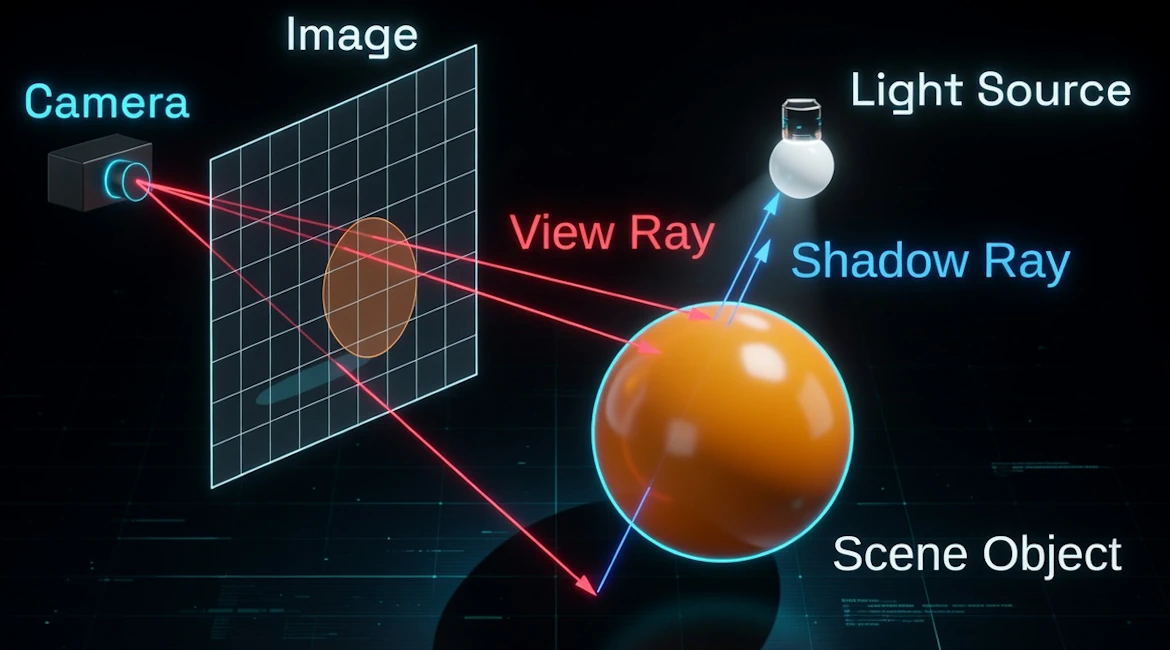
Raytracing is a rendering technique in which light is simulated physically correctly instead of just being optically approximated. While classic game graphics have long relied on so-called rasterization, raytracing pursues a much more realistic approach: Instead of calculating the scene only from the camera's perspective, the path of individual light rays is simulated.
For each pixel, a virtual light ray is sent from the camera into the scene. When this ray hits an object, the engine calculates how the light behaves on that surface. This can mean, for example, that the ray is reflected, refracted through transparent materials, or picks up indirect light from the environment. This creates realistic reflections, correct shadow progressions, and natural lighting moods as they also occur in the real world.
Reflections in particular benefit greatly from raytracing. While older methods could often only display static reflections or screen-space reflections, raytracing can also reflect objects that are outside the visible image area. This leads to significantly more believable surfaces—for example on glass, water, or polished metal.
The major disadvantage of this technique, however, is the enormous computational effort. For every frame, potentially millions of light rays must be calculated and their interactions with the scene traced. This is exactly why modern graphics cards have special hardware units—called Raytracing Cores or Ray Accelerators—that massively accelerate these calculations. Without such specialized units, real-time raytracing would hardly be feasible.
Who developed Raytracing?
The idea behind raytracing is by no means new. As early as 1968, computer graphics pioneer Arthur Appel at the IBM Research Center developed a method in which light rays are mathematically traced through a scene to determine visible surfaces. His approach laid the foundation for what later became known as raytracing.
In the late 1970s and early 1980s, researchers such as Turner Whitted significantly expanded the method. Whitted introduced, among other things, the calculation of reflections, transparencies, and shadows via light rays—a concept now known as “Whitted-Style Raytracing” and has influenced many modern rendering techniques.
Rasterization vs. Raytracing
To understand why raytracing requires so much computing power, it is worth taking a look at the classic method of game graphics: rasterization. This technique has formed the basis of almost all real-time graphics in games for decades. In this process, 3D objects are first broken down into many small triangles and then projected onto the two-dimensional screen. The graphics card then calculates the color, textures, and lighting for each pixel—usually based on simplified models.
Lighting effects such as shadows, reflections, or global light scattering are often only approximated in rasterization. Developers resort to tricks such as shadow maps, screen space reflections, or precomputed lighting information. These methods are extremely efficient and enable high frame rates, but appear less realistic in certain situations—for example with complex reflections or indirect lighting.
Raytracing pursues a fundamentally different approach. Instead of merely approximating light, the actual propagation of light rays is simulated. This makes it possible to create effects that are difficult or impossible to achieve with classic techniques: precise reflections, physically correct shadows, or naturally appearing indirect lighting.
In practice, modern games often combine both technologies. Rasterization continues to handle the majority of image computation, while raytracing is used specifically for particularly realistic effects—such as reflections, global illumination, or high-quality shadows. This so-called hybrid rendering is currently the standard in modern game engines and enables a balance between realism and performance.
What is Pathtracing?
Pathtracing is considered the physically more complete further development of raytracing. While classic raytracing usually calculates individual effects such as reflections, shadows, or specific light rays in a targeted manner, pathtracing pursues a more radical approach: It simulates the entire light transport within a scene.
The most important difference lies in how light is calculated. In traditional raytracing, often only a few rays per pixel are traced and certain effects are treated separately. Developers therefore specifically decide which light interactions should be calculated—for example reflections on glass or raytraced shadows. Many other lighting effects remain approximated or are generated via classic rasterization.
Pathtracing, on the other hand, works with stochastic light paths. For each pixel, numerous random light rays (paths) are sent into the scene, which can be reflected, scattered, or absorbed multiple times by surfaces. This automatically creates effects such as global illumination, indirect lighting, color bleeding between surfaces, soft shadows, and realistic reflections—without having to program them separately.
The price for this physical accuracy is enormous. Pathtracing requires significantly more rays per pixel and complex calculations over multiple light bounces, causing the computational effort to increase exponentially.
In gaming, pathtracing has therefore only recently been used experimentally—for example through modern GPUs, specialized raytracing hardware, and AI-supported methods such as denoising and upscaling, which can reconstruct a stable image from relatively few calculated rays. This makes a technology that was long reserved exclusively for the offline rendering world slowly usable for real-time graphics in games as well.
GPUs for Raytracing and Pathtracing
The performance of raytracing and especially pathtracing depends heavily on the architecture of the graphics card. Modern GPUs have specialized hardware units for this that accelerate the extremely complex process of ray tracing. The decisive factors are primarily Raytracing Cores or Ray Accelerators, which are optimized specifically for two central tasks: Bounding Volume Hierarchy (BVH) Traversal and Ray–Triangle Intersection Tests. These two calculations largely determine how efficiently a GPU can trace millions of rays per frame through a complex scene.

Currently, GPUs from NVIDIA's RTX series are considered leaders in the field of raytracing. Architecture generations such as Ampere (RTX 3000) and especially Ada Lovelace (RTX 4000) feature highly optimized second- and third-generation RT-Cores. This hardware can perform multiple ray-intersection tests in parallel and works closely with the Tensor Cores, which are used for AI-based methods such as DLSS and Ray Reconstruction. This combination plays a decisive role especially in pathtracing, as AI denoising and upscaling are necessary to generate a clean image from relatively few rays.
AMD GPUs with RDNA2 and RDNA3 architecture also feature dedicated Ray Accelerators that are directly integrated into the Compute Units. These also accelerate BVH traversal and ray-intersection calculations.
Upscaling Technologies: How DLSS & Co. Make Raytracing Playable at All
One of the biggest challenges of raytracing and especially pathtracing is the enormous computational load. Even modern GPUs have to calculate millions to billions of rays per second for realistic lighting. This is exactly where upscaling technologies come into play, which have become a central component of modern raytracing workloads.
The basic principle is comparatively simple: The game is first rendered at a lower internal resolution, which means significantly fewer pixels—and thus also fewer rays—have to be calculated. The image is then upscaled to the target resolution—such as 1440p or 4K—using intelligent algorithms.
Particularly well-known is DLSS (Deep Learning Super Sampling) from NVIDIA. This technology uses Tensor Cores and neural networks that have been trained on huge datasets. DLSS analyzes motion vectors, depth information, and several previous frames to reconstruct a high-resolution image that is often surprisingly close to native resolution.
Other manufacturers also offer similar solutions. AMD FSR (FidelityFX Super Resolution) works with a different approach and does not require special AI cores, while Intel XeSS also uses AI-supported upscaling methods.
These technologies are particularly crucial for pathtracing. Since extremely many light interactions have to be simulated here, upscaling is what first enables the combination of high image quality, realistic light simulations, and playable frame rates—even on powerful gaming GPUs.
Which Games Are Known for Raytracing and Pathtracing?
Some modern games have now become real technology demonstrations for raytracing and pathtracing. They show very clearly what a difference physically correct light calculation makes for atmosphere, realism, and visual depth.
Among the best-known titles is Cyberpunk 2077, which—with its later introduced “Overdrive Mode”—offers one of the first games with full pathtracing. In this setting, almost the entire lighting of the game world is calculated via pathtracing. Neon lights, reflections on wet streets, indirect lighting in interiors, and realistic shadows are created automatically through the simulation of light transport. Especially in densely built night scenes, the impressive potential of pathtracing for future games becomes clear here.
Alan Wake 2 is also considered one of the most technically demanding raytracing games. Remedy relies heavily on raytraced global illumination, reflections, and shadows to enhance the gloomy atmosphere of the game. Interiors in particular benefit from the more realistic light scattering.
Other well-known examples are Minecraft RTX, which creates a completely new visual aesthetic with fully pathtraced lighting, as well as Control, which early on showed how strongly raytraced reflections and indirect light can change the image impact.
Among the upcoming games that rely on this technology are, among others, the Gothic Remake, Witcher 4, or Control Resonant.
Frequently Asked Questions about Raytracing and Pathtracing
Answer: Raytracing calculates light rays in real time – this means:
- Millions to billions of rays per frame
- Complex light interactions (reflections, refractions, etc.)
That's why the FPS often drops significantly:
- −20% to −70% depending on the game & settings
Answer: In short: Yes, but slowly
- Currently still too hardware-hungry
- Becoming more practical with new GPUs and AI upscaling
- Already a “preview” of future graphics