
 Deutsch
 English
If you're looking for a gaming PC with an Intel processor, you usually already have a pretty clear idea of what you want. No blindly thrown-together system, no hours of researching parts, and definitely no "I hope this all fits together" feeling. You want a machine that delivers in games, handles multitasking on the side without breaking a sweat, and simply feels like a well-rounded package overall.
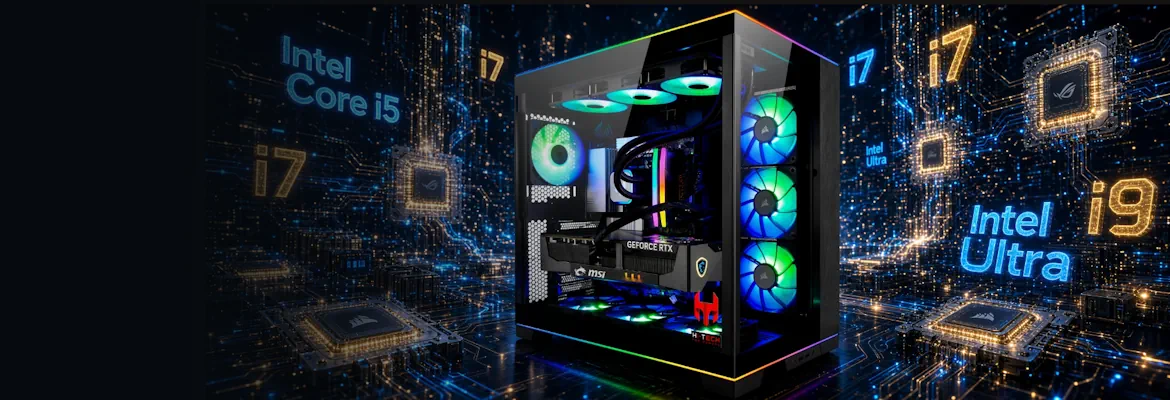
When does an Intel PC from HI-TECH make sense?
Especially when you'd rather go straight for a finished system instead of fighting your way through dozens of hardware combinations yourself. At HI-TECH for Gamers you'll find base configurations that are already sensibly matched and can still be adjusted if needed. That's exactly the kind of solution you want when you just want to play, instead of turning into a part-time hobby hardware consultant on the side.
Why a gaming PC with an Intel CPU works so well for so many people
Intel has been a fixture in gaming for years, and not without reason. Especially if you're looking for a system that doesn't just perform cleanly in games but also stays confident in everyday use, you're usually very well positioned with an Intel gaming PC.
In other words: an Intel gaming PC is exactly the kind of setup where you don't have to think twice about whether it looks like a stopgap or a real gaming machine. You get a strong base for current games, high FPS, multitasking, and all the typical side tasks that tend to run alongside gaming anyway.
Who benefits from an Intel gaming PC?
Honestly? More people than you'd initially think. An Intel gaming PC isn't just for people who can recite every new CPU generation from memory. It's also a great fit for gamers who simply want a fast, modern and uncomplicated system.
If you play in Full HD or WQHD and value smooth performance, you're already in very good shape with an Intel system. If you enjoy high FPS in fast-paced multiplayer games, plus Discord, a browser, music, or even a stream running alongside, Intel plays to its strengths there too. And if you want a system that feels just as good in everyday use as it does in gaming, Intel is a pretty obvious choice as well.
In short: Intel isn't something you go for just because "that's how it's always been done." It's still a strong option today for anyone looking for a well-rounded gaming setup.
Intel Core i5, i7, i9 or Intel Ultra – what do you actually need?
Here too: you can make it complicated. You don't have to.
An Intel Core i5 or a matching Intel Ultra 5 processor is often already a genuinely strong base if you want to play smoothly and set yourself up with a modern gaming system without going overboard. For many games in Full HD and WQHD, that's already more than solid, as long as the rest of the configuration matches it properly.
An Intel Core i7 or a stronger Ultra model is, for many, the point where "runs well" slowly turns into "runs really strong." More headroom, more breathing room for demanding games, more room for multitasking, and simply a setup that doesn't immediately break a sweat when something else is running alongside the game.
An Intel Core i9 is more the class for anyone who says: if you're going to do it, go all in. So high-end gaming, demanding applications, heavy multitasking, and generally a machine that isn't just strong today, but stays confidently ahead over the long run too.
Gaming isn't just about the CPU
Quick reality check: just because "Intel" is in the category name doesn't mean the processor alone does all the work. A good gaming PC is always a complete package. CPU, graphics card, RAM, cooling and everything else need to work together.
That's exactly why a finished system is often so convenient. You don't have to guess yourself whether component A really is the ideal match for component B. You simply pick the configuration that fits your games and your expectations, and skip that classic "I now have a powerful PC, but somehow it still feels unbalanced" feeling.
A safe bet: 40 years of experience isn't nothing
You can write a lot about tech shops. But four decades on the market speak a language of their own. HI-TECH is officially celebrating 40 years of company history in 2026, and that's already a pretty strong trust signal when buying a gaming PC.
Because in the end, it's not just about a few strong components on paper. You also want the feeling that there's a provider behind it who knows what they're doing, hasn't been in this business since yesterday, and doesn't just take nice photos of gaming hardware but genuinely understands it. That's exactly why HI-TECH for Gamers is a safe bet here. Not because that sounds especially promotional, but because you have to earn 40 years in this field first.
Which Intel gaming PC fits you?
In the end, the question isn't really "Is Intel good?" The real question is more: "What do you expect from your gaming PC?"
If you're looking for a strong system for smooth gaming without getting lost in spec sheets, an Intel PC is definitely a very good starting point. If you want high FPS, want to play in WQHD, or simply want more headroom for the next few years, it's even more worth looking at stronger Intel configurations. And if you want something that feels like real gaming hardware from the very first power-on, a well-built Intel gaming PC is pretty hard to overlook.
FAQ about Intel gaming PCs
Answer: An Intel gaming PC is simply a gaming machine built around an Intel processor. Depending on the configuration, that might be a Core i5, i7, i9, or an Intel Ultra model. What matters isn't just the CPU's name, though, but that the whole system is properly matched and runs smoothly both day to day and in games.
Answer: Yes, in many cases absolutely. An Intel i5 or a comparable Intel Ultra 5 model is often already a strong foundation for smooth gaming in Full HD and even WQHD. As always, a lot depends on the rest of the configuration, but for many players that's exactly the sweet spot where performance and value come together.
Answer: An Intel i7 is usually worth it when you want more headroom, play more demanding games, or run multitasking, streaming or other applications alongside. An Intel i9 is more for high-end demands and for anyone who deliberately wants especially strong overall performance.
Answer: Players who want a modern, powerful and uncomplicated system. Especially if you play a lot, enjoy high FPS, or keep other things running alongside gaming, an Intel system can be a really good fit.
Answer: That's exactly one of the nice things about HI-TECH's base configurations. You start with a sensibly put-together system and can adjust it further to your needs whenever you want, instead of having to start completely from scratch.
Answer: Because you're not landing with just any provider who happened to put a few PCs online. HI-TECH has been around since 1986 and celebrates its 40th anniversary in 2026. Especially with gaming hardware you want to be able to rely on, that's a pretty strong argument.