
 Deutsch
 English
If you're looking for an AMD Gaming PC, you usually already have a rough idea of where you want to go. No half-measures, no wild parts lottery, and definitely no hours spent comparing ten nearly identical CPUs with cryptic model names. You want a system that delivers when gaming, is set up with modern hardware, and ideally won't sour your mood at the next hardware upgrade.
Note: Configure your PC according to the requirements table to ensure the stated performance.
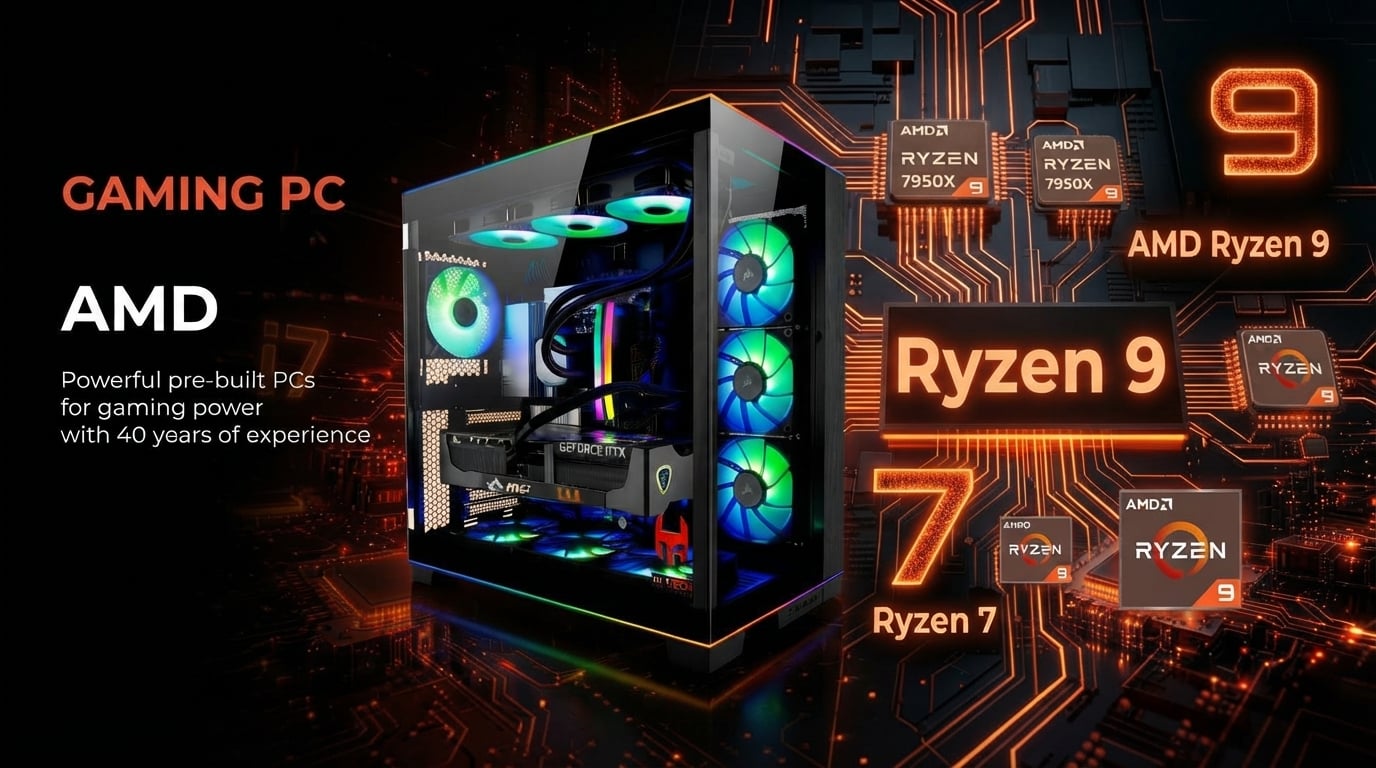
When does an AMD PC from HI-TECH make sense?
Especially when you don't want to build it yourself but would rather go for a finished PC that's been cleanly put together and built for gaming. At HI-TECH you get exactly these kinds of base configurations, already sensibly set up and still adjustable if needed. And yes, that's a pretty relaxed way to go if you just want to play instead of wading through forum myths and compatibility lists.
Why a gaming PC with AMD is so popular in the first place
Ryzen processors in particular are, for many gamers, exactly the mix they want: strong performance, a modern platform, and enough headroom so the machine doesn't just run well today but is still fun to use tomorrow.
In other words: an AMD gaming PC is often exactly the kind of setup where you don't feel like you're buying yourself into a dead end. You get a strong base for gaming, often for streaming and multitasking too, or the usual side battlefield known as "I've got 17 tabs open, Discord's running, Spotify too, and someone's streaming on the second monitor."
Who benefits from an AMD gaming PC?
Honestly? Quite a lot of people. An AMD gaming PC isn't just for people who know every single benchmark chart by heart. It's also a great fit for gamers who simply want a well-rounded, modern system.
If you mainly play in Full HD and want high detail settings with smooth FPS, a good AMD system already puts you well ahead. If you're eyeing WQHD or want current AAA games to look gorgeous instead of "yeah, it kind of runs," AMD gets especially interesting. And if you also stream, record, edit, or generally do more than just hit the start button alongside gaming, then Ryzen systems are a pretty obvious choice anyway.
In short: AMD isn't just for tech enthusiasts. It's also for people looking for a machine that simply feels like a good purchase in everyday use.
Ryzen 5, Ryzen 7 or Ryzen 9 – what do you actually need?
This is usually made unnecessarily complicated. But it doesn't have to be.
A Ryzen 5 is often already exactly right if you want a strong entry into gaming. For many games in Full HD or WQHD, that already goes a really long way, especially if the rest of the configuration is properly matched.
A Ryzen 7 is, for many gamers, a bit of a sweet spot. Enough power for demanding games, enough headroom for streaming, multitasking, and the years ahead. If you don't want to upgrade every two minutes and would rather go straight for a strong all-round base, that's usually the pretty sensible choice.
A Ryzen 9 is more the option for people who say: "Alright, let's do this properly." So high-end gaming, demanding applications, very strong overall performance, and generally a setup that doesn't even glance nervously at the fan curve under heavier tasks.
On your site, exactly these classes show up in the lineup too, from Ryzen 5 systems as an entry point up to stronger Ryzen 7 and Ryzen 9 configurations in the higher-end range.
Gaming isn't just about the CPU
A quick, friendly reality check: just because "AMD" is in the category name doesn't mean the processor alone is throwing the party. A good gaming PC always stands or falls with the combination of CPU, graphics card, memory and the rest of the configuration.
That's why the strongest CPU doesn't get you far if the graphics card doesn't match it. And the other way round is just as true. The nice thing about a finished gaming PC is exactly that: you don't have to work out that balance yourself from scratch. You pick the system that matches your games and your expectations, without the feeling of accidentally ordering a sports car with bicycle tires.
A safe bet: 40 years of experience isn't nothing
You can say a lot about marketing. But 40 years on the market aren't just some nice slogan. In the tech and gaming world, that's a real statement. HI-TECH is officially celebrating 40 years of company history in 2026 and puts the anniversary front and center. The anniversary page also highlights exclusive insights into the company and a retrospective theme built around trust.
And honestly: when you buy a gaming PC, you don't just want nice specs on a product page. You also want the feeling that there's a provider behind it who knows what they're doing, has been around for a long time, and won't vanish into the digital bushes at the first small hiccup. That's exactly why HI-TECH for Gamers can already be called a safe bet here. Not because that sounds especially promotional, but because four decades in this field have to be earned first.
Which AMD gaming PC fits you?
In the end, the question isn't really "Is AMD good?" The real question is more: "What do you want to do with your gaming PC?"
If you're looking for a well-rounded setup for smooth gaming without getting lost in hardware details, an AMD system is almost always a good starting point. If you want more headroom, are going for WQHD, or play games that aren't exactly getting less demanding going forward, it's even more worth looking at stronger Ryzen configurations. And if you want something that looks like a real gaming machine not just today but a few years from now too, a well-built AMD gaming PC is hard to ignore anyway.
FAQ about AMD gaming PCs
Answer: An AMD gaming PC is basically just a gaming machine built around an AMD processor — usually a Ryzen. But what's interesting about it isn't just the name on the spec sheet, it's the whole package. When the CPU, graphics card, and the rest of the configuration match up cleanly, you get a system that does exactly what it should while gaming: deliver solid performance without putting you in a bad mood the moment a new game comes out.
Answer: Yes, in many cases absolutely. A Ryzen 5 is already a strong foundation for many gamers and is often more than enough for smooth gaming in Full HD or even WQHD — always depending, of course, on the rest of the configuration. For many players, that's exactly the class where you don't feel like you're getting too little performance without going completely overboard.
Answer: A Ryzen 7 usually gets interesting when you want a particularly strong all-round system — so gaming plus streaming, multitasking, or simply a bit more headroom for the coming years. A Ryzen 9 is more the drawer for people who deliberately want to go high-end. That pays off especially when other demanding applications come into play alongside gaming.